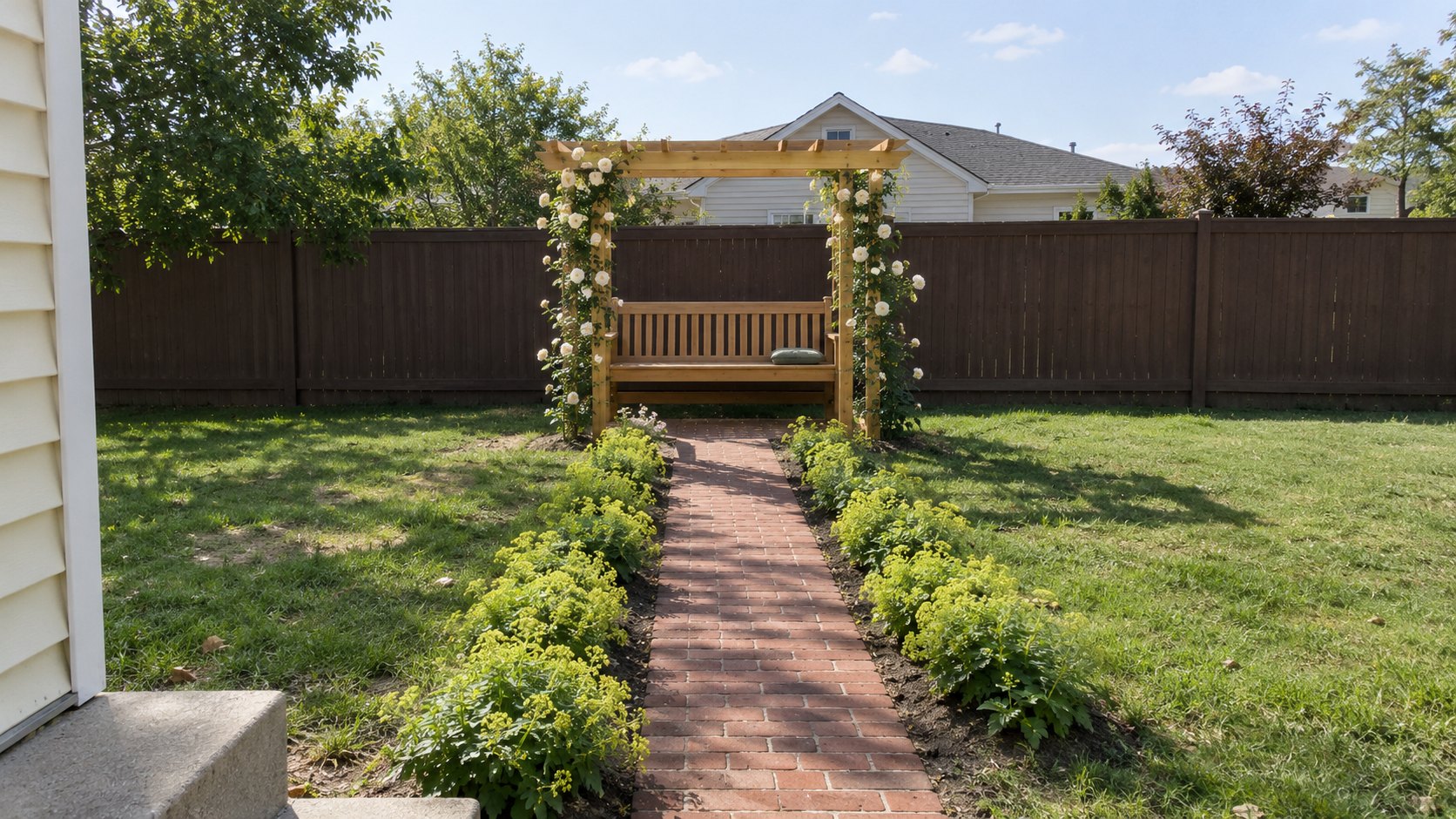
Arbor Ideas: 15 Designs for a Garden Entrance or a Climbing Rose
Arbor ideas work best when the frame marks a real way in: a gate, a path, or a seat at the end of one.
These 15 designs give the clear size, the posts and a climber that suits each frame.
Measure inside the posts, and set them below the frost line.
Find your arbor
1. A Flat-Top Cedar Arbor With the Side Gate Hung Between Its Posts

Hang the gate on the arbor’s own posts and the fence, gate and frame read as one entrance. A swinging gate pulls hard on its hinge post, so both posts go in concrete below your frost line.
Coral honeysuckle twines up a post on its own and flowers best in full sun.
2. A Slim Black Steel Arch Where the Front Walk Meets the Sidewalk
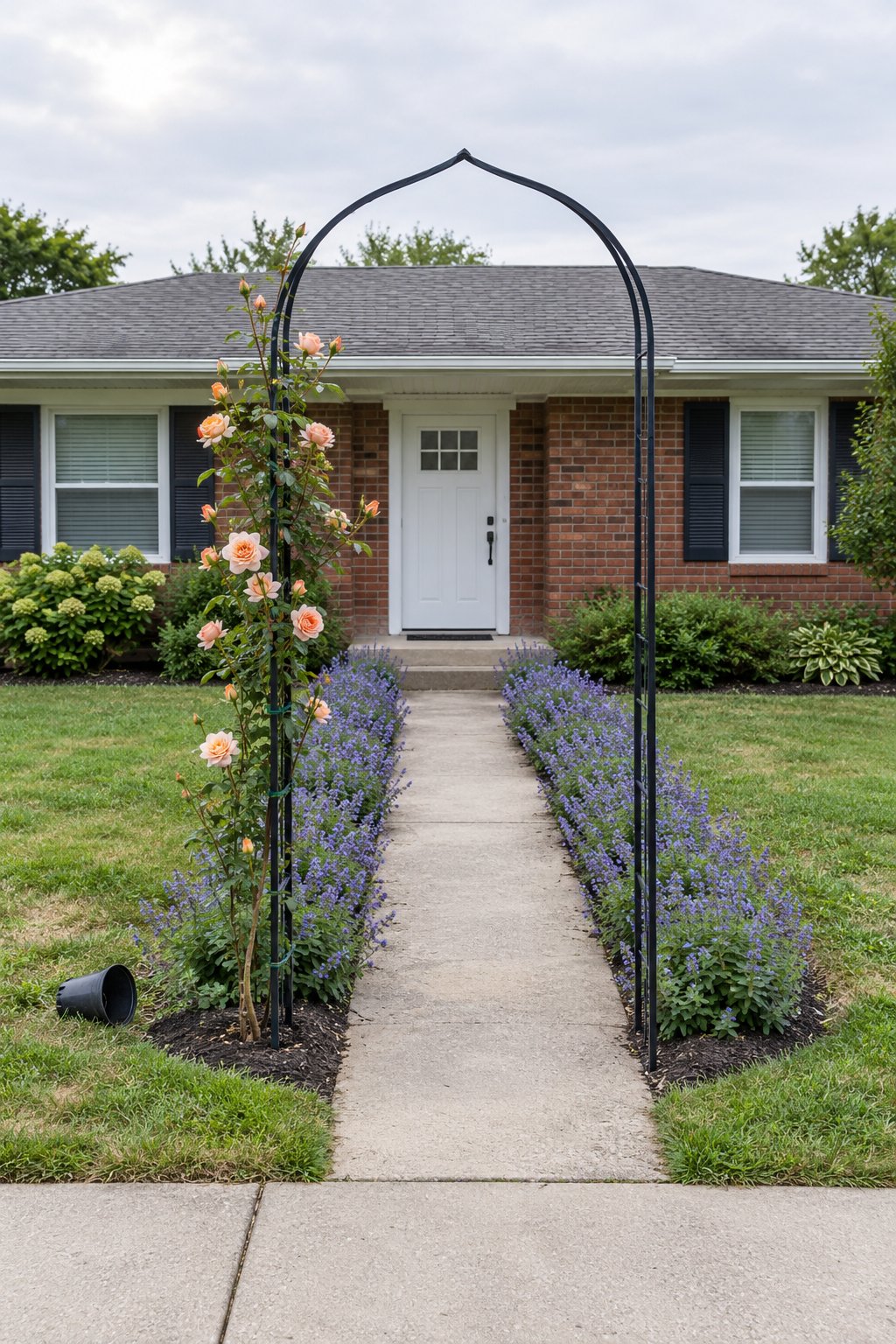
An arch at the street end of the walk tells visitors where to turn in, even with no fence. Set it a couple of feet back from the sidewalk so rose canes never snag a passerby.
One climbing rose on the sunnier post is plenty, and it wants at least 6 hours of sun.
3. An Arbor as the Door Into a Fenced Vegetable Garden, With Cucumbers Up Both Sides

An arbor over the vegetable garden gate gives the plot a front door and a climbing frame in one. Keep at least 3 feet clear so a loaded wheelbarrow rolls straight through.
Vining cucumbers climb it in summer, planted after your last frost once the soil warms.
4. A Wide Timber Arbor at the Driveway Gate, Clear for the Mower

Measure the widest thing you push into the backyard, usually the mower, and leave at least a foot to spare. That span is too wide for a light kit, so build this one from timber posts and doubled beams.
Common hop covers it fast in full sun, then dies to the ground each winter and gets cut down.
5. A Freestanding Arbor Between Lawn and Garden, With Boxwood Wings

An arbor alone in a lawn looks stranded. Run a short boxwood hedge out from each post and it becomes a threshold, the line where the lawn ends and the garden begins.
This frame needs no vine at all, because the hedge does the job a fence would.
6. An Arbor Bench at the End of the Path, a Climbing Rose Wound Up Each Post
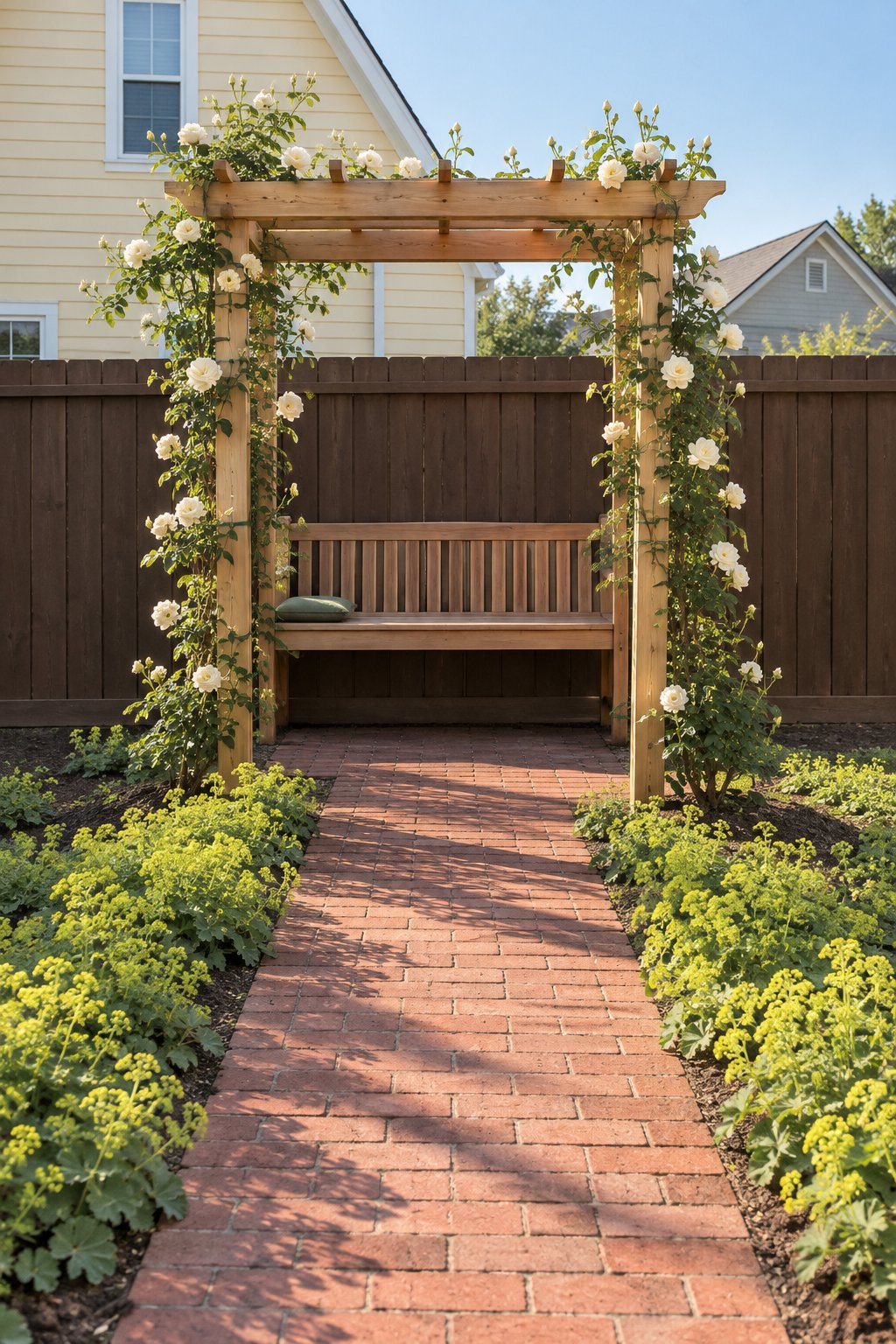
A path needs somewhere to arrive, and a bench under an arbor gives the eye and the feet the same goal. Wind one or two long canes up each post and tie them every 8 to 12 inches with soft ties.
Canes bent toward horizontal flower more, so spiral them instead of tying them straight up.
7. A Deep Arbor Seat in Part Shade, Roofed in Dutchman’s Pipe

For a shadier seat, pick a climber grown for its leaves. Dutchman’s pipe has big heart-shaped leaves, takes sun to part shade and can climb 20 feet or more in a season.
It grows big and dense, so give it solid posts and a slatted roof to hold it.
8. Two Arches in a Row Over a Gravel Path, Roses With a Late Clematis Through Them

Two matching arches set 4 to 5 feet apart and joined by side rails turn one entrance into a short tunnel. Lay the gravel on a packed base, as in my garden path ideas.
A late-flowering clematis grown through the roses blooms after them, so the tunnel flowers twice.
9. One Arbor Halfway Down a Narrow Side Yard, With Hostas in Pots

A long side yard reads as one dull corridor until something interrupts it. Set an arbor about halfway along and you get two short rooms, which feels bigger than one long one.
Most flowering climbers want more sun than a side yard gets, so let shade plants in pots do the work.
10. An Arbor at the Top of the Garden Steps, Set Plumb on the Landing
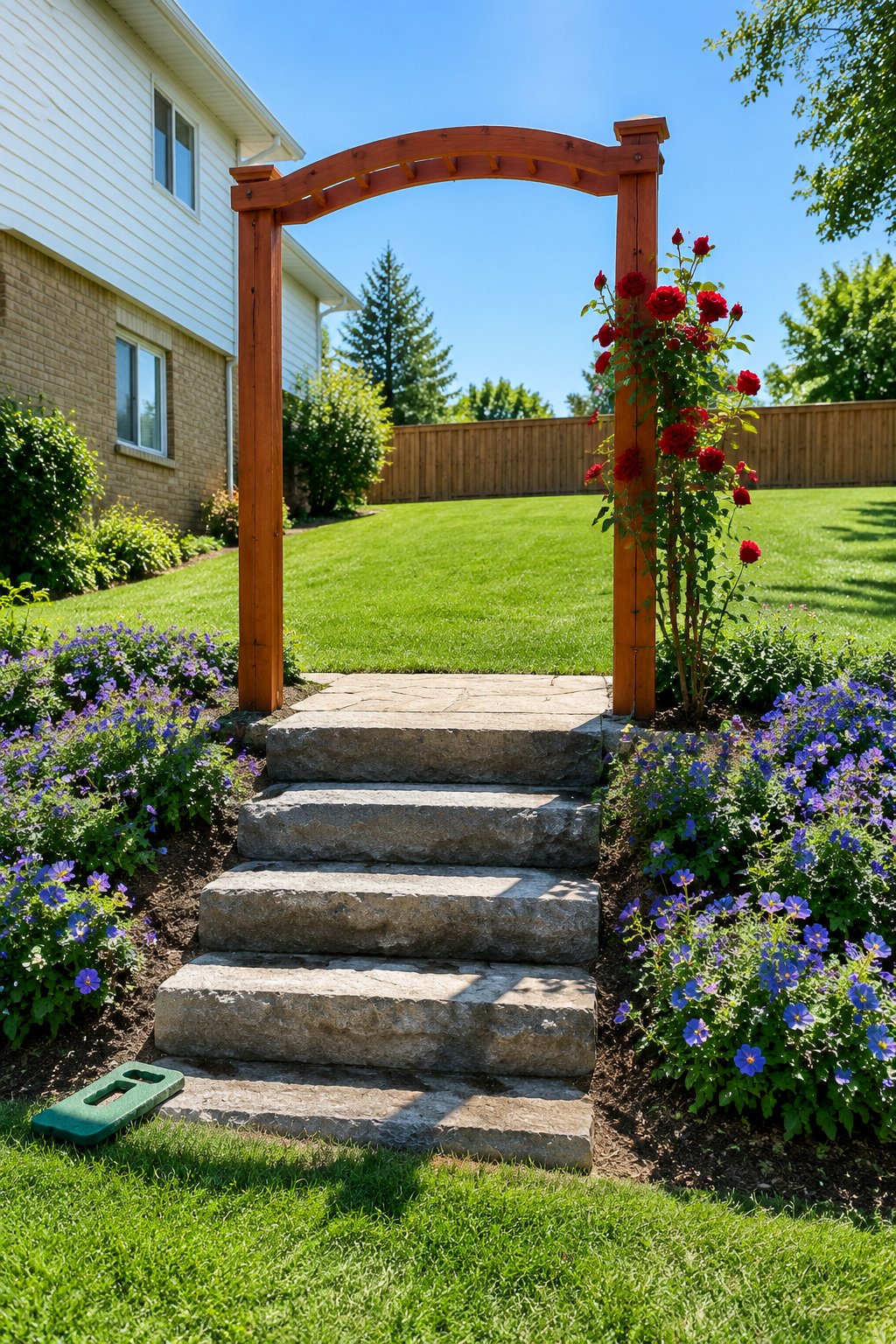
An arbor at the top of a short flight of steps frames the climb and marks the arrival. Stand it on the flat landing, never straddling a step, so both posts start from the same level.
On a slope, check each post with a level on two faces before the concrete sets.
11. A Heavy Cedar Arbor for American Wisteria, Left to Weather Silver
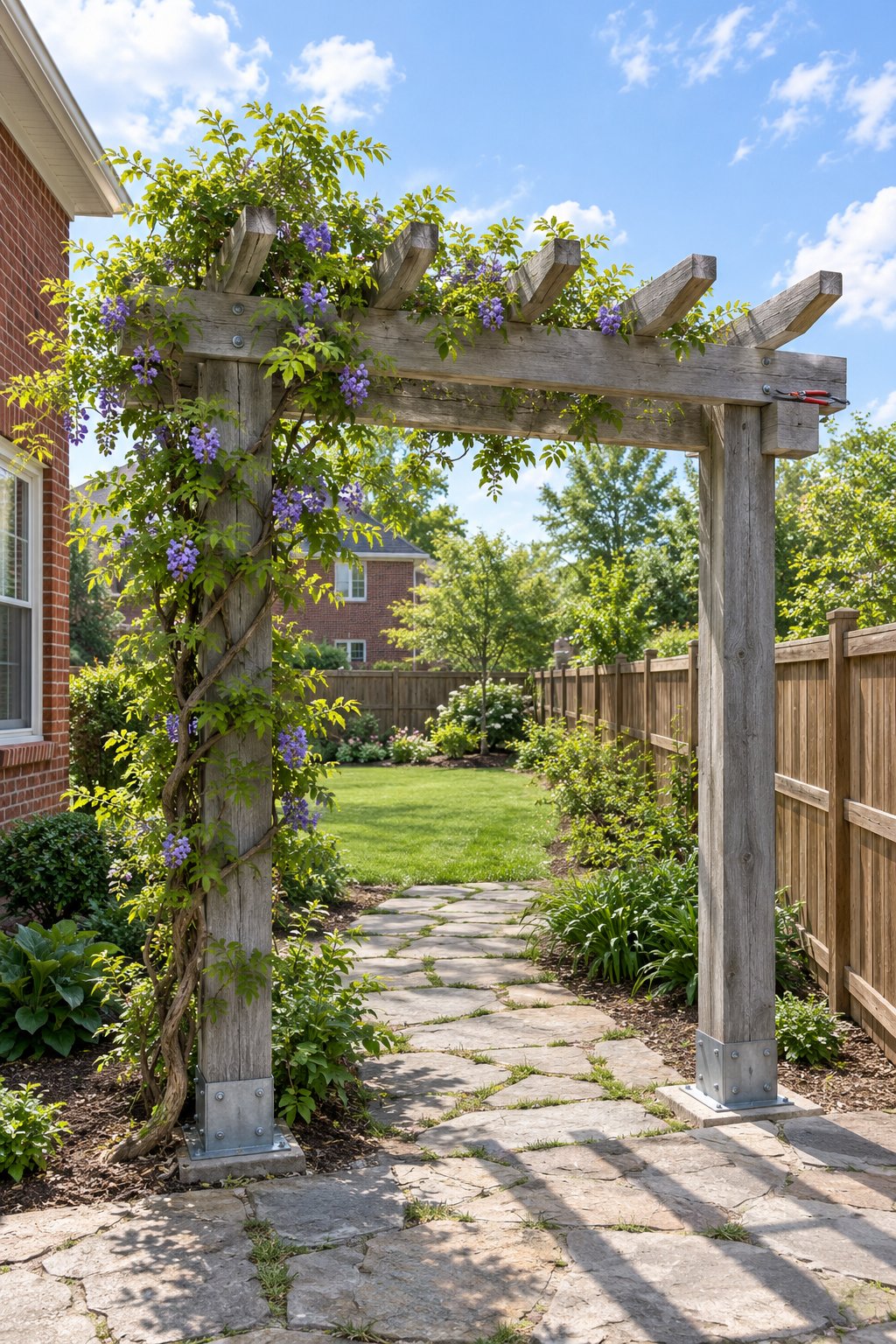
Wisteria gets heavy, so it needs the stoutest frame on this list: thick cedar posts and doubled beams. Untreated cedar is not made for ground contact, so stand the posts on metal bases bolted to concrete footings.
Plant American wisteria, never the invasive Chinese or Japanese kinds.
12. A Slim Steel Arch for a Large-Flowered Clematis

Clematis climbs by wrapping its leaf stalks around thin supports, so an arch of narrow bars suits it better than chunky wood. Give it a top in sun and shaded roots, with a low plant or mulch over them.
Large-flowered kinds bloom in May and June in many areas, right on time for a spring entrance.
13. A White Vinyl Arbor Into the Patio, With a Mandevilla in a Pot at Each Post

Vinyl never needs paint, which suits an arbor you want looking the same every year. A hollow frame is light, so follow the kit’s anchoring exactly.
Mandevilla is a tropical vine, so in most of the US it grows as a summer pot plant.
14. A Painted Arbor Over the Path to the Shed, With a Late Clematis Cut Back Each Winter

An arbor in front of a shed turns a storage building into somewhere you head on purpose. Set it out past the door’s swing, so the door still opens all the way.
A late-flowering clematis suits it, because you cut it back hard each late winter and the arbor stands bare for a fresh coat of paint.
15. A Renter’s Arch Set Into Two Planters, Covered by Purple Hyacinth Bean

Set each leg of a steel arch deep into a large planter of soil, so nothing is dug or fixed to the building. A vine-covered arch catches wind, so use the heaviest planters you can.
Hyacinth bean is an annual twiner for full sun, sown after frost and pulled out in fall.
Arbor Sizes on One Page
Every design above rests on a few figures.
Check them against the kit or the plan and your town’s rules before you dig.
| What | The figure | Why |
|---|---|---|
| Clear width for walking through | About 4 feet between posts | Leaves room once a vine grows in from both sides |
| Clear width for a wheelbarrow | At least 3 feet | The least a loaded barrow needs |
| Clear headroom | About 7 feet under the top | Rose canes and vines hang down into the opening |
| Post depth | About a third of the post, below the frost line | A rule of thumb; your building department knows the local frost depth |
| Concrete in frost areas | About 6 inches below the frost line | One arbor maker’s spec, so ground heave cannot lift the posts |
| Ties on a climbing rose | Every 8 to 12 inches, soft and loose | Tight ties cut into canes as they thicken |
Six Arbor Mistakes to Skip
Sizing the opening for a bare frame
Do thisLeave about 4 feet between posts, because a vine growing in from both sides takes several inches of the opening.
Posts held by short stakes in the lawn
Do thisSet posts about a third of their length deep and below the frost line, or follow the kit’s anchors exactly. A covered arbor catches wind like a sail.
A heavy vine on a light kit
Do thisWisteria, hops and Dutchman’s pipe want thick posts in concrete. Keep a slim steel arch for clematis and annual vines.
Planting the invasive climbers
Do thisSkip Chinese and Japanese wisteria, sweet autumn clematis and Japanese hop. American wisteria, a large-flowered clematis or common hop fill the same spots.
Tight ties around rose canes
Do thisUse soft, loose ties and check them every winter, because a tie that fits today cuts in as the cane thickens.
An arbor with nothing on either side
Do thisPut it on a real route, a gate, a path, a seat or a shed door, or run a short hedge or fence out from each post.
Buy the Inside Measurement, Not the Box Size
Arbor listings usually give the outside size, and the opening you walk through is narrower by both posts and any lattice sides. Look for a clear or interior figure, or measure between the posts yourself.
Then take a few more inches off each side for the vine, because a covered arbor is narrower than a bare one.
Headroom works the same way: one 78-inch kit lists 75.5 inches of head clearance and 39 inches inside, and an arched top drops lower toward the posts. How much a vine adds depends on how it holds on, which I cover in how each kind of climber holds on.
I would rather build an arbor a little too big than squeeze past a rose every morning.
Start with the opening you walk through most, measure it, and set two posts there properly before you buy a single plant. For the beds around it, my cottage garden ideas pair well with any of these frames.
The climber can wait a season, but a post set badly has to be dug out to fix.
Frequently Asked Questions
How wide should a garden arbor be to walk through?
About 4 feet between the posts suits one person once a vine fills in, and at least 3 feet clear lets a wheelbarrow through. Check the clear inside width, not the outside size on the box.
How tall should an arbor be?
Aim for about 7 feet of clear headroom under the top, because rose canes and vines hang down into the opening. Many kits list less, so read the clearance figure.
How deep do arbor posts need to go?
A common rule is about a third of the post in the ground and below your frost line, set in concrete. Your building department can tell you the local frost depth, and call 811 before you dig.
What is the best climber for an arbor?
In sun, a climbing rose or a large-flowered clematis; in part shade, Dutchman’s pipe; for one summer, an annual such as hyacinth bean. Match the vine’s weight to the frame, and never plant Chinese or Japanese wisteria.
Can a renter put up an arbor?
Yes, if it needs no digging: stand a steel arch in two heavy planters and grow an annual vine. Ask the landlord before putting anything on the lawn.
You Might Also Like
Save This For Later
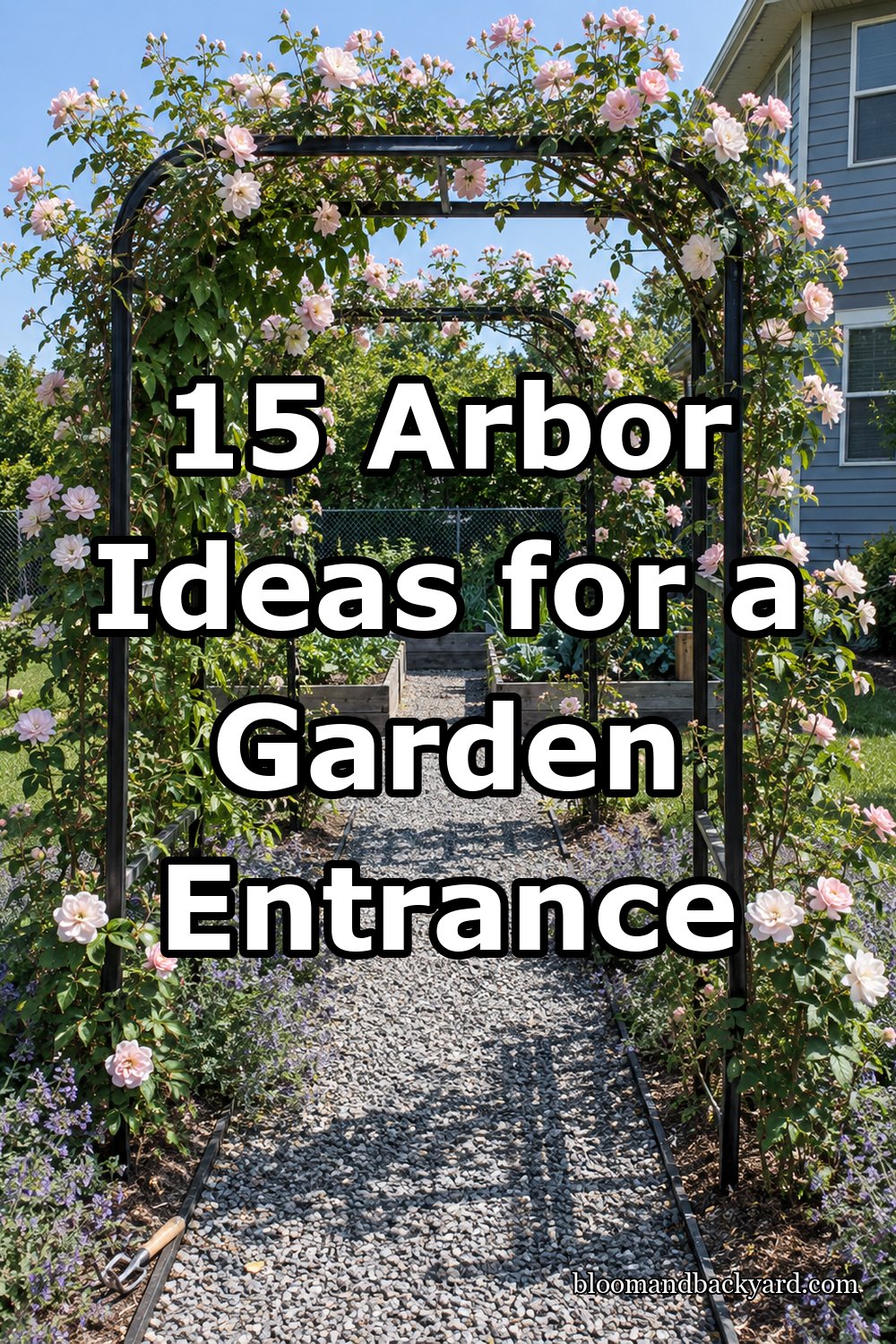
Loved arbor ideas? Save this pin to your Pinterest board now so you can find it again anytime you need the inspiration.