Garden Design Ideas: 16 Layouts That Work in Real Yards

Garden design ideas are easier to use when they come as a whole layout: a bed shape, a path, a place to look and a planting plan.
These 16 are drawn for ordinary yards, from a square lawn to a corner lot.
Each one names the sun it needs and what it takes to build.
What shape is your yard?
1. A Lawn Framed by a Six-Foot Border on Three Sides
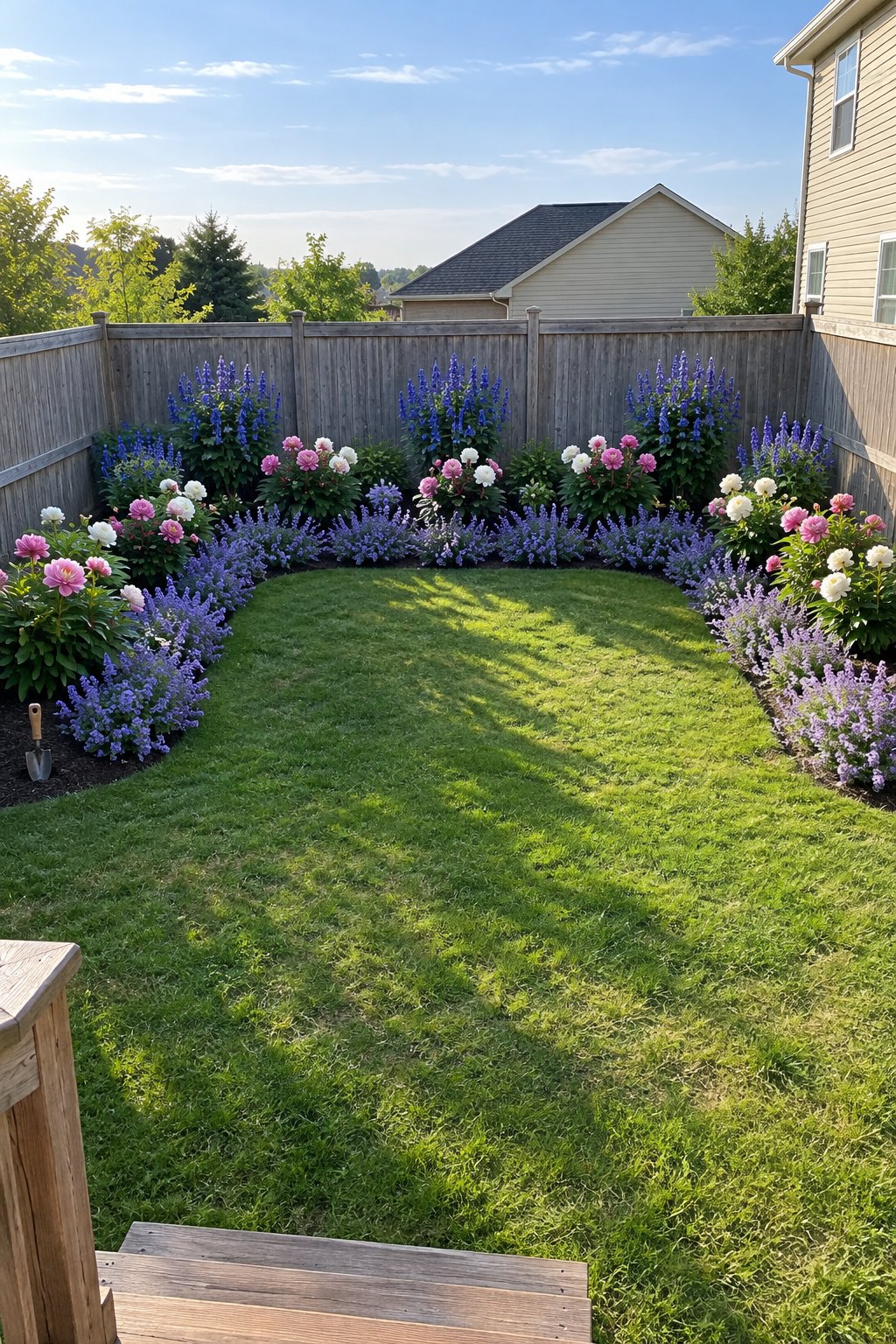
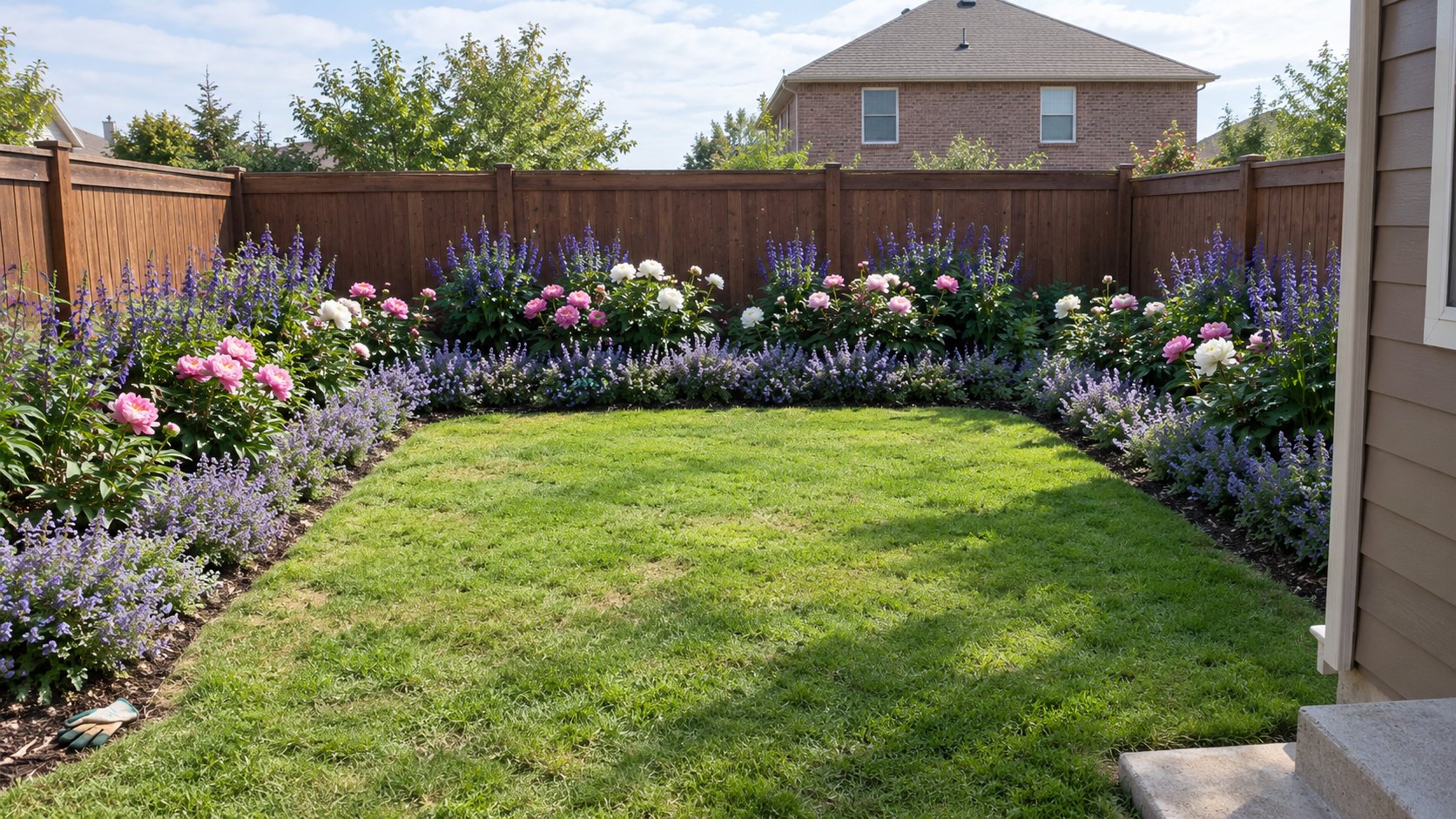
A square yard looks designed when the lawn is the open space and a border wraps three of its sides. Make the border 6 feet deep and keep plants under 4 feet, two thirds of its depth.
Blue false indigo stands at the back, peonies fill the middle and catmint spills along the front.
2. A Diagonal Path to a Bench in the Far Corner

A square’s diagonal is about 1.4 times its side, so a path set corner to corner is the longest walk the yard has. A bench in the far corner gives the eye a place to land.
A dwarf Korean lilac behind the bench blooms in mid-May, and bigroot geranium lines the path.
3. Four Equal Beds Around a Birdbath

A formal yard rests on symmetry: four matching beds, a gravel crossing and one focal point where the paths meet. A birdbath on a gravel circle at the center gives every path the same ending.
Edge each bed with a low inkberry holly hedge and plant one kind of bearded iris in a block.
4. A Small Garden as One Room: Gravel Floor, Planted Walls, One Tall Focal Point
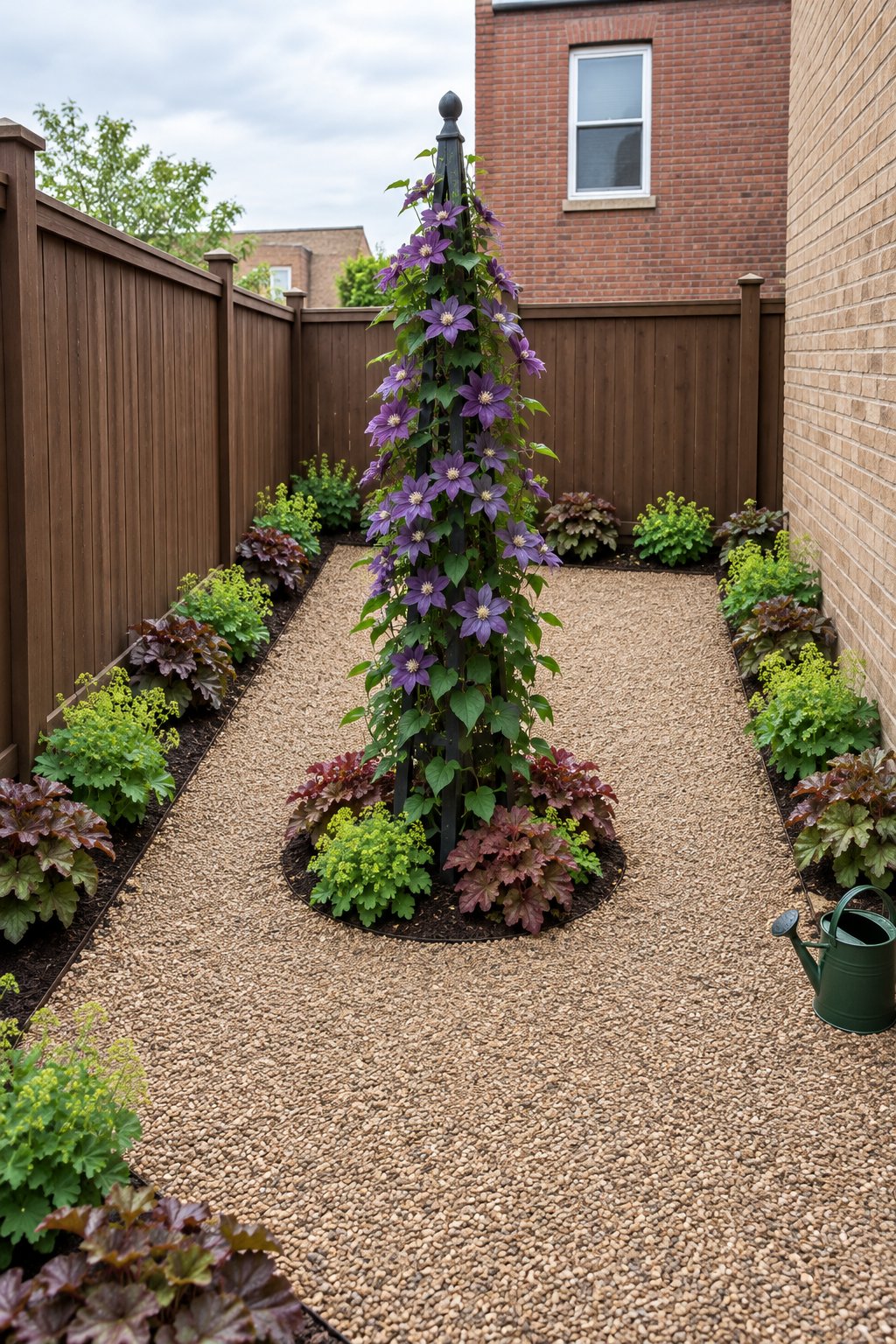
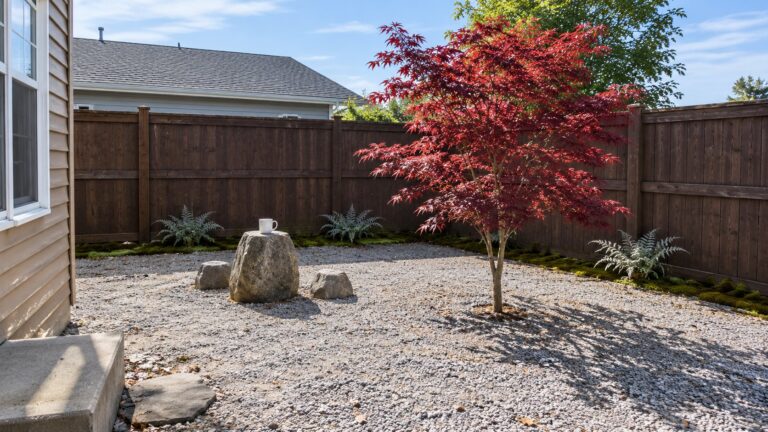
Small garden design ideas work when the yard is one room with a floor, walls and one thing to look at. Pea gravel is the floor, beds 2 feet deep line three fences and an obelisk stands in the middle.
An early large-flowered clematis climbs the obelisk, with coral bells and lady’s mantle shading its roots.
5. Two Bends in a Long Yard That Hide the Far End

A long, narrow yard stops feeling like a hallway when you cannot see the end of it. Bend the path twice and set a deep bed on the outside of each bend.
A Vanhoutte spirea grows 6 to 8 feet tall and often wider, so one at each bend blocks the next view.
6. A Shady Side-Yard Walk That Ends at a Bench

A side yard is a passage, and a path that ends at nothing stays one. Run stepping stones down the middle, plant both edges and finish at a bench so the walk has a destination.
Brunnera, foamflower, Solomon’s seal and Christmas fern all suit shade, and the fern stays green all year.
7. A Wedge-Shaped Yard Opened Up Like a Fan
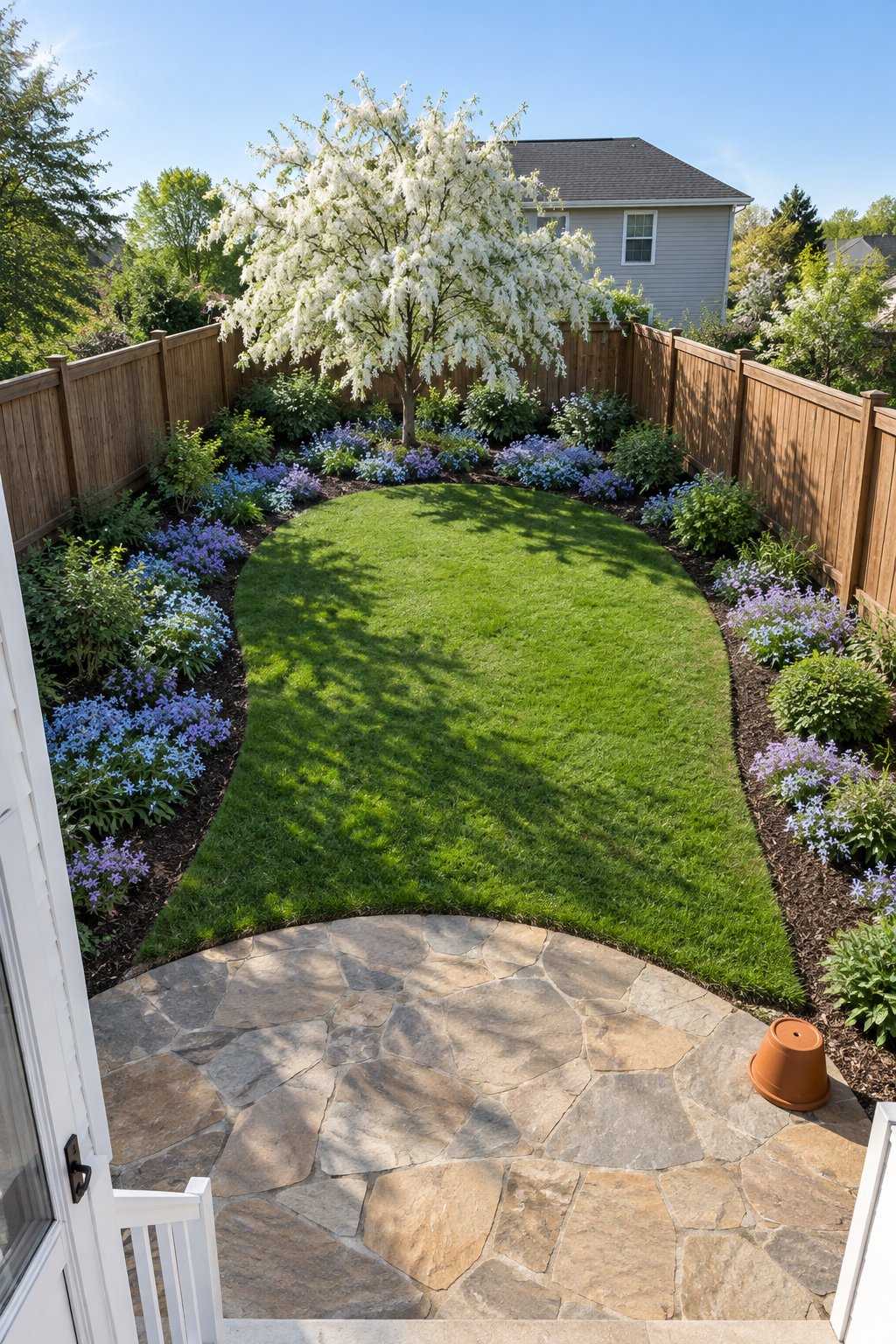
A pie-shaped lot, narrow at the house and wide at the back, suits curves that fan out the same way. Put the patio at the narrow end and the biggest plant where the yard is widest.
One fringe tree, 12 to 20 feet tall, blooms in May or June, with bluestar and woodland phlox beneath it.
8. One Long Border Planted in Tapering Drifts
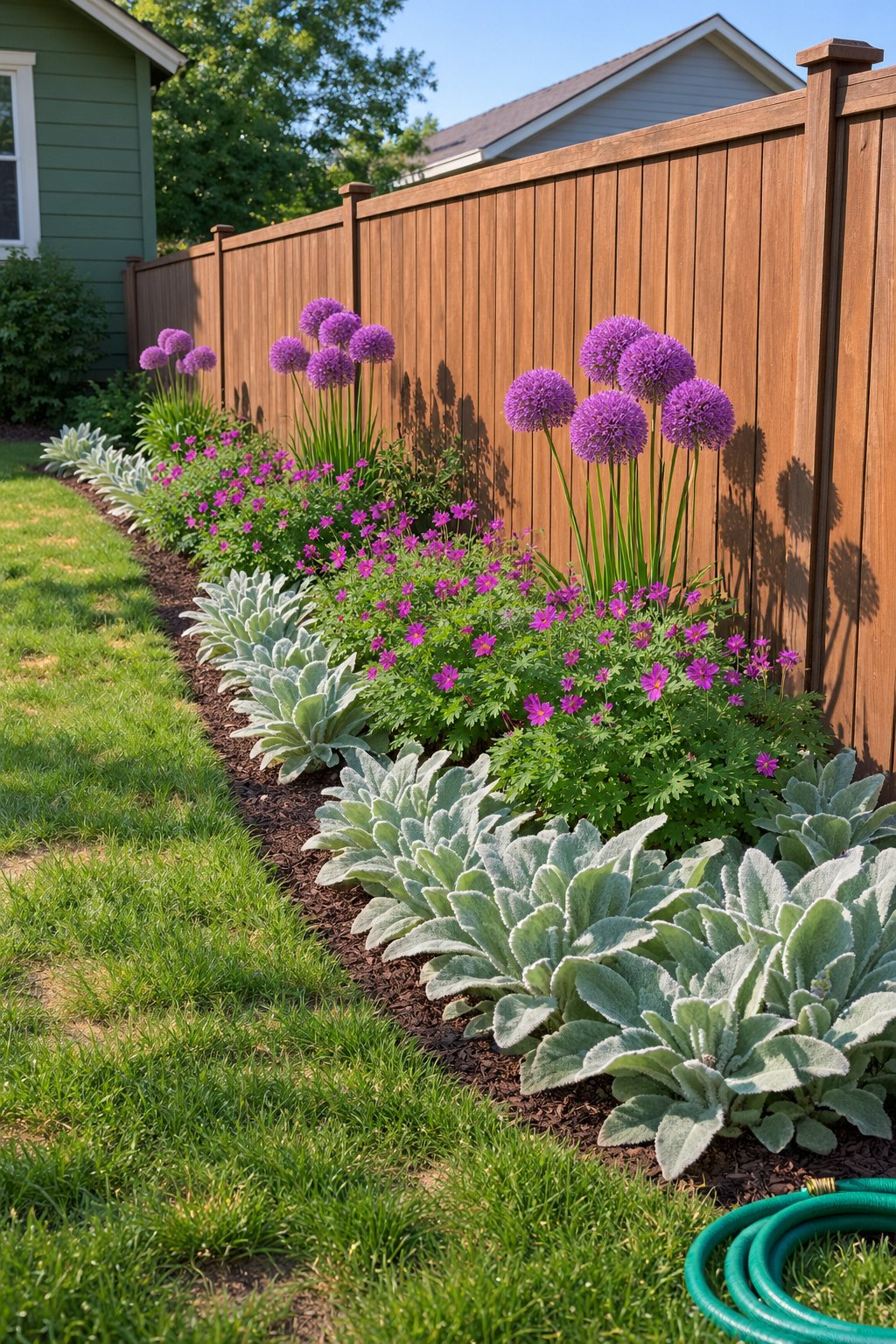
A drift is a long, narrow group of one plant, and a border reads as calm when it is built from a few. Extension advice is five to seven plants per group, and a border that tapers away from the house looks longer.
Lamb’s ear sits in front, bloody cranesbill in the middle and ‘Purple Sensation’ alliums rise behind.
9. A Corner Lot: Low at the Intersection, Tall Along the Side Street
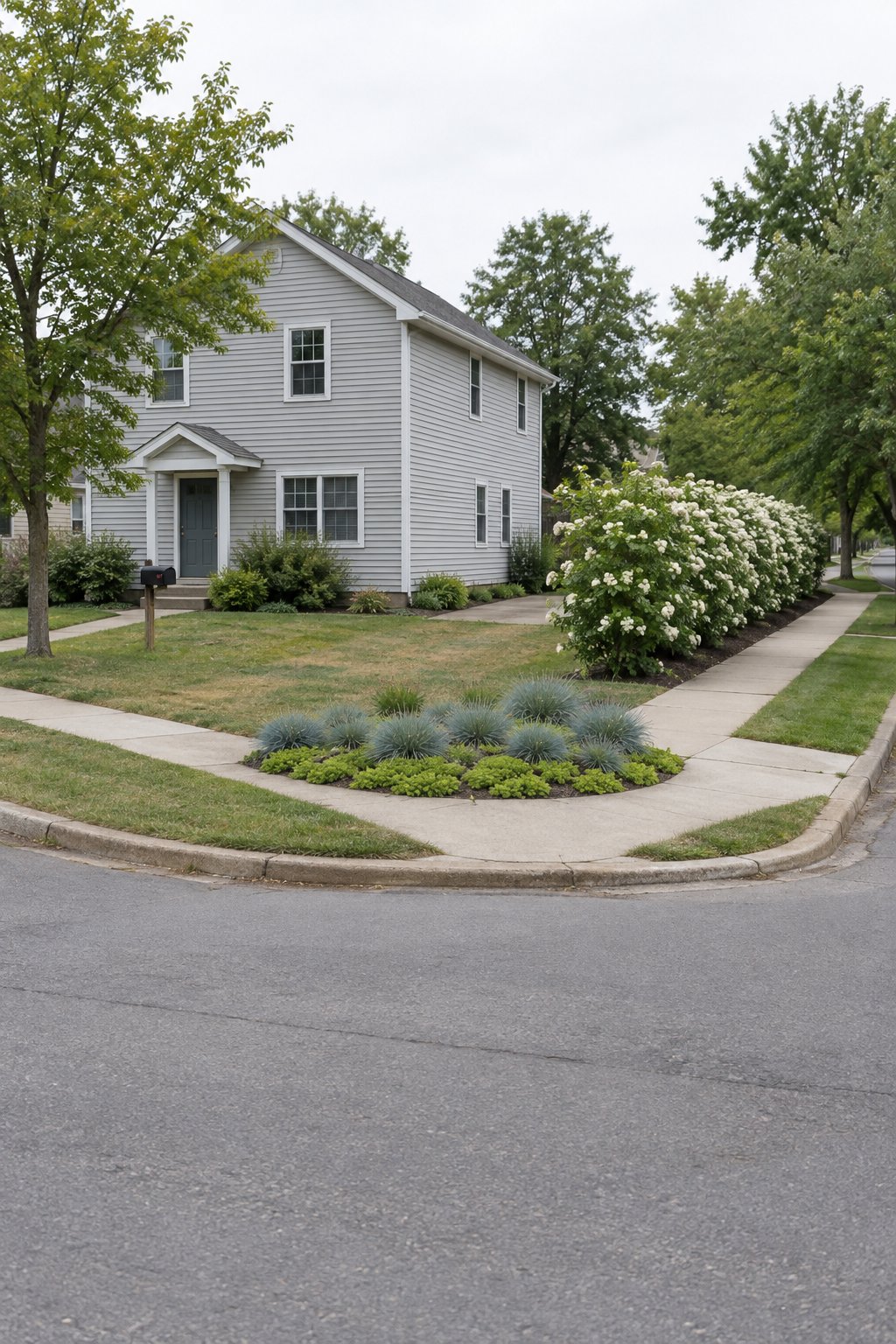
A corner lot needs a clear view at the intersection and privacy along the side street. Keep the corner low and bring height only beyond the sight triangle, which my front yard landscaping ideas explain.
Many towns cap anything in that triangle at about 30 inches, so call your planning office first.
10. A Slope Climbed on a Switchback Path With Planting Bands

A bank that drops 1 foot in every 3 is too steep to mow, so plant it and cross it on a path at an angle. Two long diagonals with a level landing at the turn keep the climb gentle.
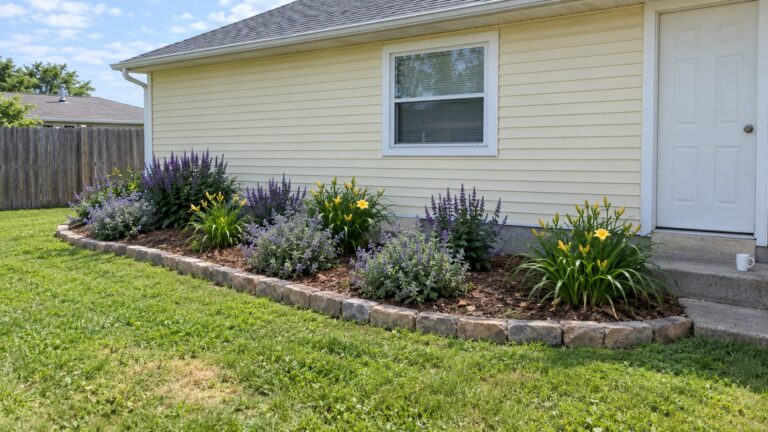
‘Gro-Low’ fragrant sumac roots where its stems touch soil, moss phlox carpets the face and daylilies sit at the foot.
11. A Three-Tier Hedgerow Along the Back Fence for Birds and Bees

Extension guides on planting for wildlife recommend layers, from a small tree down to ground plants, because birds and insects use each one. Step the border down from tree to shrub to flowers along the back fence.
One serviceberry is the top layer, ninebark the middle, and wild columbine and wild geranium the floor.
12. A Loop Path Around an Oval Island Bed on a Family Lawn

A loop never dead-ends, so kids, dogs and mowers get a circuit and nobody cuts across the bed. Lay a 4-foot loop of pavers or packed gravel around an oval island, and the rest of the lawn stays open.
Put the tallest plant in the middle so the island reads from every side: a compact weigela, then spirea, then sedum.
13. A Cottage Front Garden Behind a Low Picket and a Gate

A front garden feels like an entrance when it has a threshold: a low picket, a gate and a curved path beyond. Make the path 4 feet wide, enough for two side by side.
Siberian iris stands at the back, ‘Rozanne’ geranium fills the middle and cheddar pinks edge the path.
14. Modern Rectangles Planted in Three Repeating Plants

A modern layout is geometry plus restraint: three rectangular beds set flush beside a paver walk, each planted with the same three things. Repeating one grass, one perennial and one bulb makes a small front yard read as one idea.
‘Karl Foerster’ feather reed grass runs 4 to 5 feet tall, with Russian sage in front and alliums between.
15. A Front Yard Balanced Off-Center: One Tree, One Wide Bed

Front garden design ideas can be lopsided on purpose: one big shape on one side, balanced by a wider area of lower planting on the other. Put one tree on the lawn at the left and a wide bed against the house at the right.
A kousa dogwood flowers in late May or June, and three dwarf fothergilla over Pennsylvania sedge fill the bed.
16. A Meadow Patch With a Mown Edge
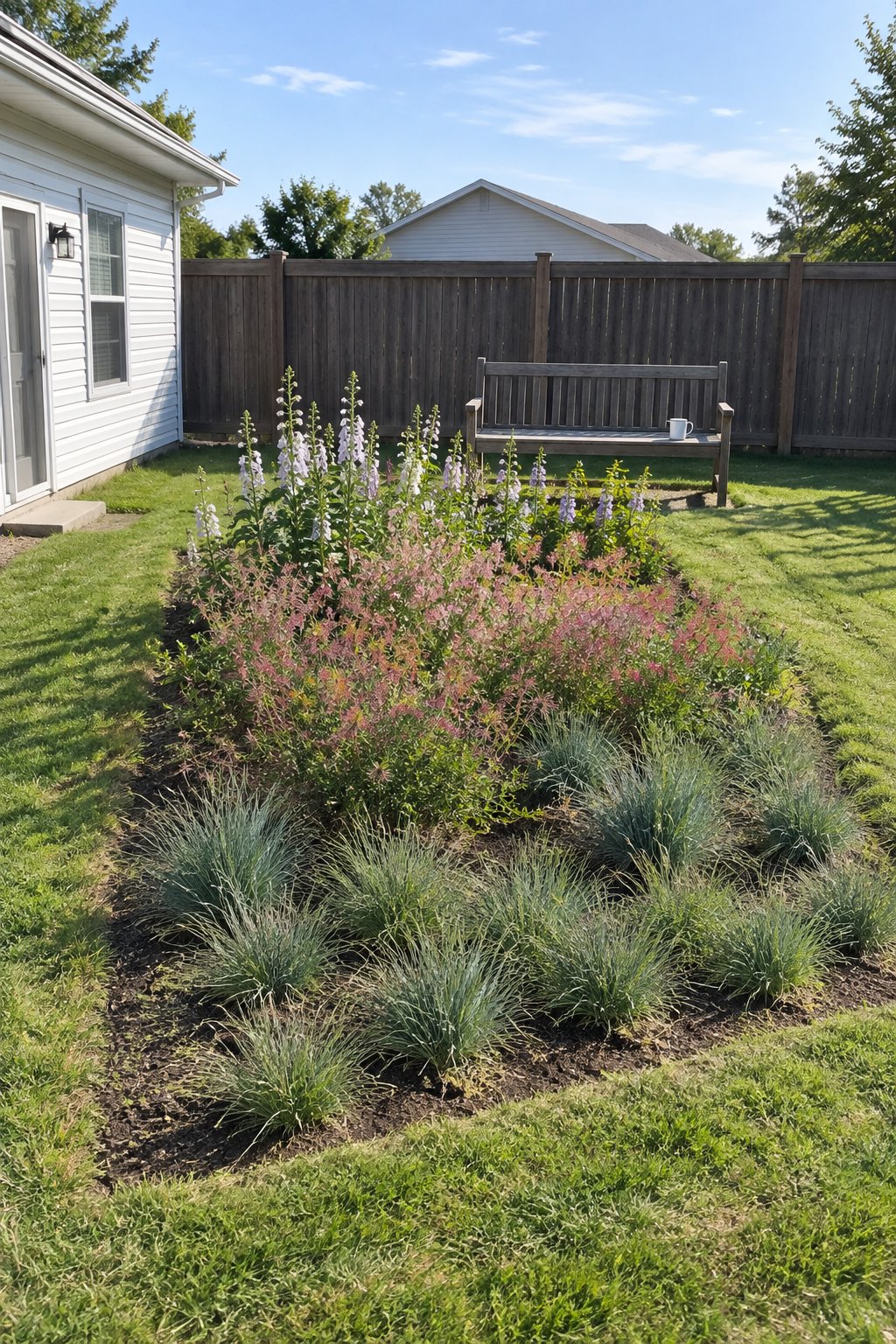
A patch of tall flowers and grass reads as planned, not neglected, when a mown strip runs along its edge. Researchers call that kind of frame a cue to care.
Foxglove beardtongue, prairie smoke and little bluestem fill a 10 by 20 foot patch, with a 3-foot mown strip around it.
Layout Numbers on One Page
Every layout above rests on a few figures.
Check them against your own yard and your town’s rules before you dig.
| What | The figure | Why |
|---|---|---|
| Path width | About 2 feet to walk, 3 for a wheelbarrow, 4 for two side by side | The width decides how the path gets used |
| Bed depth | 2 to 3 feet in a small yard, 6 to 8 in a roomy one | Extension guidance for flower borders |
| Tallest plant | No more than two thirds of the bed’s depth | A 6-foot border takes plants up to 4 feet |
| Planting groups | Five to seven plants per drift | Fewer looks spotty, a mix of singles looks checkerboard |
| Slope | A drop of 1 foot in 3 is too steep to mow | Plant it and cross it on a path instead |
| Sight triangle | Often 30 inches maximum height near a corner | Your town sets the exact limit, so ask |
Six Garden Layout Mistakes to Skip
A bed too shallow for its layers
Do thisGive three layers at least 4 feet of depth, and keep the tallest plant to two thirds of that.
A path that ends at nothing
Do thisEnd every path at a seat, a gate, a pot or a view, so the walk has a reason.
Plants lined up by height like a fence
Do thisLet a few tall plants step forward into the middle row so the height line is broken.
A main path too narrow for two
Do thisMake the path you use most 4 feet wide, and keep side paths for single file at about 2 feet.
A bench facing a blank wall
Do thisTurn the seat toward the best view in the yard and put a shrub or a fence behind it.
A ruler-straight edge on an informal bed
Do thisLay a hose in a long, gentle curve and cut to that line, unless the style is formal.
Plant for Year Three: Why a New Layout Looks Empty
A new border looks thin because you spaced the plants for their size in year three, not year one.
Most perennials build roots the first season, flower more in the second and fill out by about the third.
Space each plant by the mature width on its tag, and cover the bare soil between them with 2 to 3 inches of mulch. Cheap annuals sown in the gaps can fill the space until the perennials meet.
I’d photograph the bed every spring, because growth is easier to see in pictures than to remember.
Pick the layout closest to your yard’s shape, copy its path width and bed depth, then swap in plants that suit your zone.
A layout that works on the ground first is one you won’t have to replant.
Frequently Asked Questions
How wide should a garden bed be?
In a small yard a bed may be only 2 or 3 feet deep, while a roomy yard can take 6 to 8 feet. Three layers fit best at 4 feet or more.
How wide should a garden path be?
About 2 feet is enough to walk single file, and 3 feet takes a wheelbarrow. Make your main path 4 feet if two people will walk it side by side.
Which of these garden layout ideas suits a long, narrow yard?
Start with nos. 5, 6 and 8: bends that hide the far end, a shaded side-yard walk and a tapering border. No. 7 suits a wedge-shaped lot.
How much sun do these layouts need?
Most want 6 or more hours of direct sun. Nos. 6 and 11 and the wall beds in no. 4 suit shade or part shade.
When should I plant them?
Spring or fall suits most perennials, but alliums go in as bulbs in fall. Check your zone and your last frost date with your county extension office.
You Might Also Like
Save This For Later
Loved garden design ideas? Save this pin to your Pinterest board now so you can find it again anytime you need the inspiration.