Hot Tub Ideas Backyard: 18 Setups for Decks, Patios and Small Yards
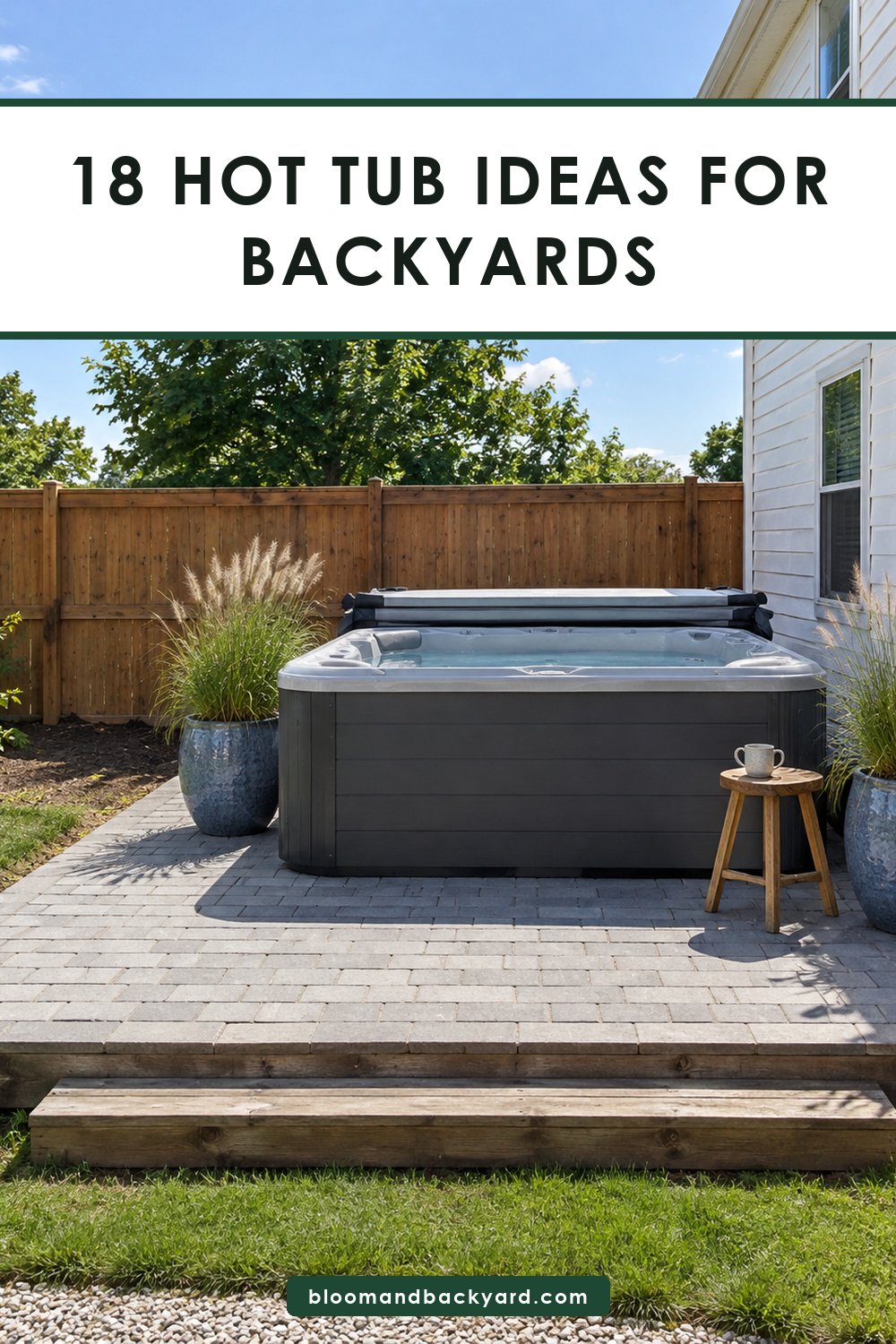
Hot tub ideas for the backyard only work if the ground, the power and the cover are sorted before the tub arrives.
These 18 setups run from a plug-in inflatable to a hard-shell on a pad, and each one says what it takes.
A full tub is heavy, and wiring a big one is an electrician’s job.
What kind of yard do you have?
1. Inflatable Tub on a Concrete Patio, on a Mat and Close to an Outlet

Inflatable hot tub ideas for a backyard start with a flat, smooth surface with nothing sharp on it, and a swept slab is about the easiest one you will find. Put a ground sheet and foam tiles under it.
Plug it into a GFCI-protected outlet within reach of its own cord, never through an extension cord.
2. Renter Setup: An Inflatable on a Paver Patio You Can Drain and Pack Away

An inflatable needs no footings and no holes, which is why it suits a rental. Pick the flattest paved spot, put a ground sheet down and ask your landlord in writing before you fill it.
Water is heavy, and a lease or a patio may not allow it.
3. Tuck an Inflatable Into a Back Corner Behind a Slat Screen

A corner gives you two fences of privacy before you add a thing. Set one freestanding slat screen on the open side, a few feet off the tub, so you can still walk around it.
Keep a clear path to the outlet and the cover, not a maze of cords.
4. Plug-In Hard-Shell for Two or Three on a Crushed Stone Pad

Some smaller hard-shell tubs run on a standard 120-volt supply, which skips the heavy wiring a big tub needs. They usually seat two to four and heat slowly.
Most still want their own GFCI-protected circuit, and a new outlet is an electrician’s job.
5. Six-Seat Hard-Shell on a Reinforced Concrete Pad

The standard setup is a hard-shell tub on a level concrete pad, commonly 4 inches thick and reinforced, though the maker’s spec comes first. The whole base should sit flat on the pad with no rocking.
A full-size tub usually needs a dedicated 240-volt GFCI-protected circuit from a licensed electrician.
6. Pour the Pad, Then Lay a Paver Landing for Steps and a Bench
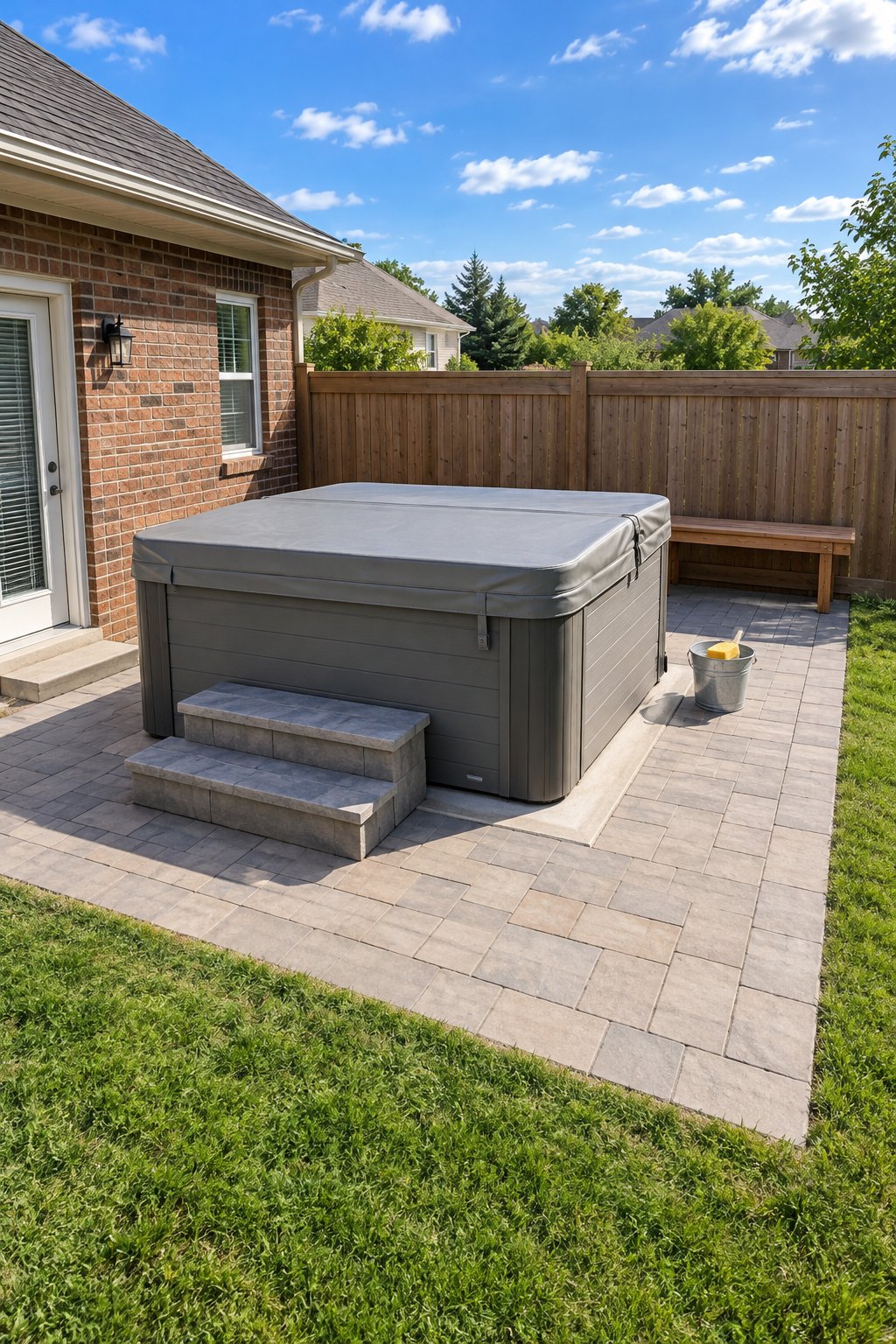
Pour the pad for the tub and lay pavers around it as a landing, so wet feet land on something other than slick lawn. Leave room on the equipment side so the panel can come off for service, often 2 to 3 feet.
Choose a rough, non-slip surface and pitch it slightly away from the tub.
7. Give the Tub Its Own Pad Beside the Deck and Link Them With Steps

A pad on the ground next to a deck keeps the weight off the boards. A short run of steps from the deck door brings you straight to the tub.
The deck stays a deck, and the tub gets the foundation it needs.
8. Fence, Gate and Locking Cover for a Yard With Kids

Children are the reason for the rules. The CPSC says to use a locked safety cover whenever the spa is not in use, and to keep young children away unless an adult is watching all the time.
Fence and gate rules vary by town, so ask before you build.
9. Inflatable on a Deck Only After the Framing Is Checked

A four-person inflatable can weigh well over a ton once it is full and people are in it, and one maker’s manual cites about 2,400 pounds. Many decks are built for about 40 to 60 pounds per square foot.
Have an engineer or a deck builder check the framing before you fill it.
10. Reinforce the Deck Under a Hard-Shell With Extra Posts and Footings

A hard-shell can sit on a deck only if the frame below is built for it, with added joists, posts and footings directly under the tub. Trade sources work from a design load of about 100 pounds per square foot or more.
The design is an engineer’s job, and the work often needs a permit.
11. Sunken Look: Frame the Deck Around the Tub With a Lift-Out Panel

A tub with its rim near deck level looks built in. It still needs its own firm base, and a recessed tub needs a floor drain so water cannot collect around it.
Make one deck section removable, because the side panels have to come off for service.
12. Narrow Side-Yard Pad for a Two-Seat Tub, Gate Width First

Measure every gate, corner and low eave on the route in, because many tubs are wheeled in on their side and the shell height is the narrowest opening you must clear. A crane is sometimes the only way, and it costs extra.
A tub that will not fit through the gate never gets set.
13. Slope? Cut a Level Pad Into the Hill Behind a Low Wall

On a slope, dig back into the hill to make a flat pad and hold the uphill side with a low retaining wall. Build the pad on undisturbed soil, not loose fill, which can settle under the weight.
A tall wall or a stack of tiers is an engineer’s job.
14. Close Neighbors? Slat Panel, Tall Planters and Seats Facing the Fence

Hot tub privacy ideas start with where the seats face. Turn them toward a fence or your own house, and add a slat panel and two tall planters on the neighbors’ side.
Check your town’s noise rules and quiet hours, because pump noise carries at night.
15. Pots and Grasses Around the Pad, Kept Back From the Cover

Hot tub landscaping ideas work best in planters set a few feet back, so leaves and petals stay out of the water. Use gravel or pavers right beside the tub, because loose bark mulch floats and blows.
Pick plants for your sun and zone from the tag, and keep branches clear of the cover.
16. Beat the Afternoon Sun With Open Beams and a Shade Sail

Open rafters give partial shade and let steam drift away, and a sail across the top cuts the glare. Measure the cover’s full swing before you set a post, or the raised lid will hit a beam.
Hang no fan or light over the tub without an electrician, because the code sets minimum heights above the water.
17. Cold Winters: Keep It Near the Door With a Tight Cover and a Windbreak

Put the tub close to the back door, keep a path cleared and keep the cover on tight, since in hard cold a cover left off for a few hours can let the water turn slushy. A plain wood windbreak on the windward side helps.
Keep it powered and know what your tub’s freeze protection does.
18. Low Path Lights, Solar Lanterns and Towel Hooks, With No Cords Across the Ground

Low, warm lights along the path and at the steps show the edges without lighting up the neighbors. Choose outdoor-rated low-voltage or solar lights and keep them out of the splash zone.
Never run an extension cord to the tub, or a cord across a wet path.
Hot Tub Numbers on One Page
Every idea above rests on a few figures.
Check them against your own tub’s manual and your town’s rules before you build anything.
| What | The figure | Why |
|---|---|---|
| Weight of water | About 8.34 pounds a gallon | A 400-gallon tub holds about 3,300 pounds of water alone |
| Load under a filled tub | Often about 100 pounds per square foot or more | Many decks are built for about 40 to 60, so a deck needs a check |
| Pad under a hard-shell | Commonly 4 inches of reinforced concrete, or 4 to 6 inches of compacted crushed stone | Follow the maker’s spec, and ask whether gravel keeps the warranty |
| Water temperature | 104 degrees F or lower | The CPSC’s advice for spas |
| Overhead service wires | At least 22.5 feet above the water | The electrical code’s clearance, so check with an electrician |
| Barrier at a house | Often 48 inches high, or a lockable cover | Rules vary by town, so ask your building department |
Six Hot Tub Mistakes to Skip
Filling it before checking the base
Do thisFind the tub’s filled weight and footprint, then match the pad or deck to them. A lawn or an ordinary deck is not built for that load.
Running power from a spare outlet
Do thisUse the circuit the maker specifies, with GFCI protection. A 240-volt circuit or a new outlet is a licensed electrician’s job, and your town may want a permit.
An extension cord to an inflatable
Do thisPlace the tub within reach of an outlet, because the makers’ manuals say no extension cords. Have an electrician add an outlet if you need one.
Leaving the cover unlocked
Do thisLock it whenever the tub is not in use, and keep young children away unless an adult is watching all the time.
Setting it where service cannot reach
Do thisLeave room on the equipment side so the panel can come off, often 2 to 3 feet. Measure every gate on the delivery route before you buy.
Letting the water run hotter than 104 F
Do thisKeep the water at 104 degrees F or lower, as the CPSC advises, and skip alcohol while you soak.
What a Full Hot Tub Weighs, and What Your Ground Has to Carry
Water weighs about 8.34 pounds a gallon, so a tub that holds 400 gallons carries about 3,300 pounds of water before the shell or anyone in it is counted.
That is why a lawn, a thin paver patio or an ordinary deck is the wrong place for a filled tub.
Trade sources work from a design load of roughly 100 pounds per square foot or more under a filled tub, while many decks are built for about 40 to 60. Your tub’s spec sheet lists its dry weight, water capacity and footprint, so add the first two, allow for the people, and divide by the footprint.
If your number is anywhere near what the surface can carry, I would ask an installer or a structural engineer before I filled anything.
Start with the base and the power, not the tub: find the filled weight, decide where the pad or the framing comes from and have an electrician look at the circuit. Then add the cover lock, the screen and the lights.
Get the ground, the wiring and the lock right first, and the rest is easy to add later.
Frequently Asked Questions
Do I need an electrician to install a hot tub?
For a full-size 240-volt tub, yes: a licensed electrician should run a dedicated GFCI-protected circuit, and your town may want a permit and an inspection. Most plug-in inflatables run on a GFCI-protected outlet, but follow the manual and never use an extension cord.
How much does a hot tub weigh when it is full?
A filled six-person tub often passes 5,000 pounds with people in it, and trade sources use about 100 pounds per square foot or more as a design load. Check your tub’s spec sheet, then ask an installer or an engineer.
Can I put a hot tub on a deck?
Only if the framing under it is built for the load, which usually means added joists, posts and footings designed by an engineer. A low, ground-level deck is the safer choice.
Do I need a fence around my hot tub?
It depends on your town. Many model codes accept a lockable safety cover in place of a fence at a house, but some places still ask for a barrier of about 48 inches, so ask your building department.
What is the highest safe water temperature?
The CPSC advises keeping spa water at 104 degrees F or lower. It also warns that drinking alcohol in a spa can lead to drowning, and that young children should stay away unless an adult is watching all the time.
You Might Also Like
Save This For Later

Loved hot tub ideas backyard? Save this pin to your Pinterest board now so you can find it again anytime you need the inspiration.